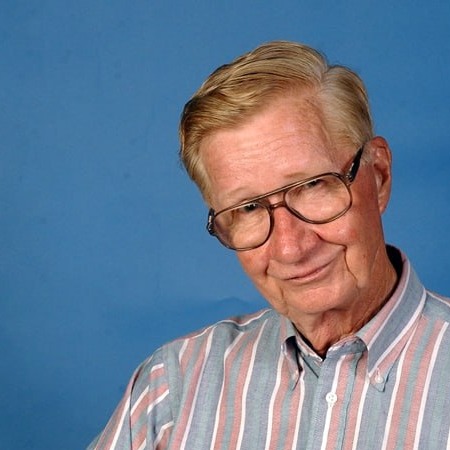
Bob's words came alive through other people's voices. He wrote the material — the comedy, the toasts, the lyrics — and handed it off to performers who brought it to audiences across South Louisiana and beyond. But some of his words took on lives of their own, pressed not onto vinyl but onto wood, ceramic, and kitchen walls across Acadiana.
The Decoupage Art
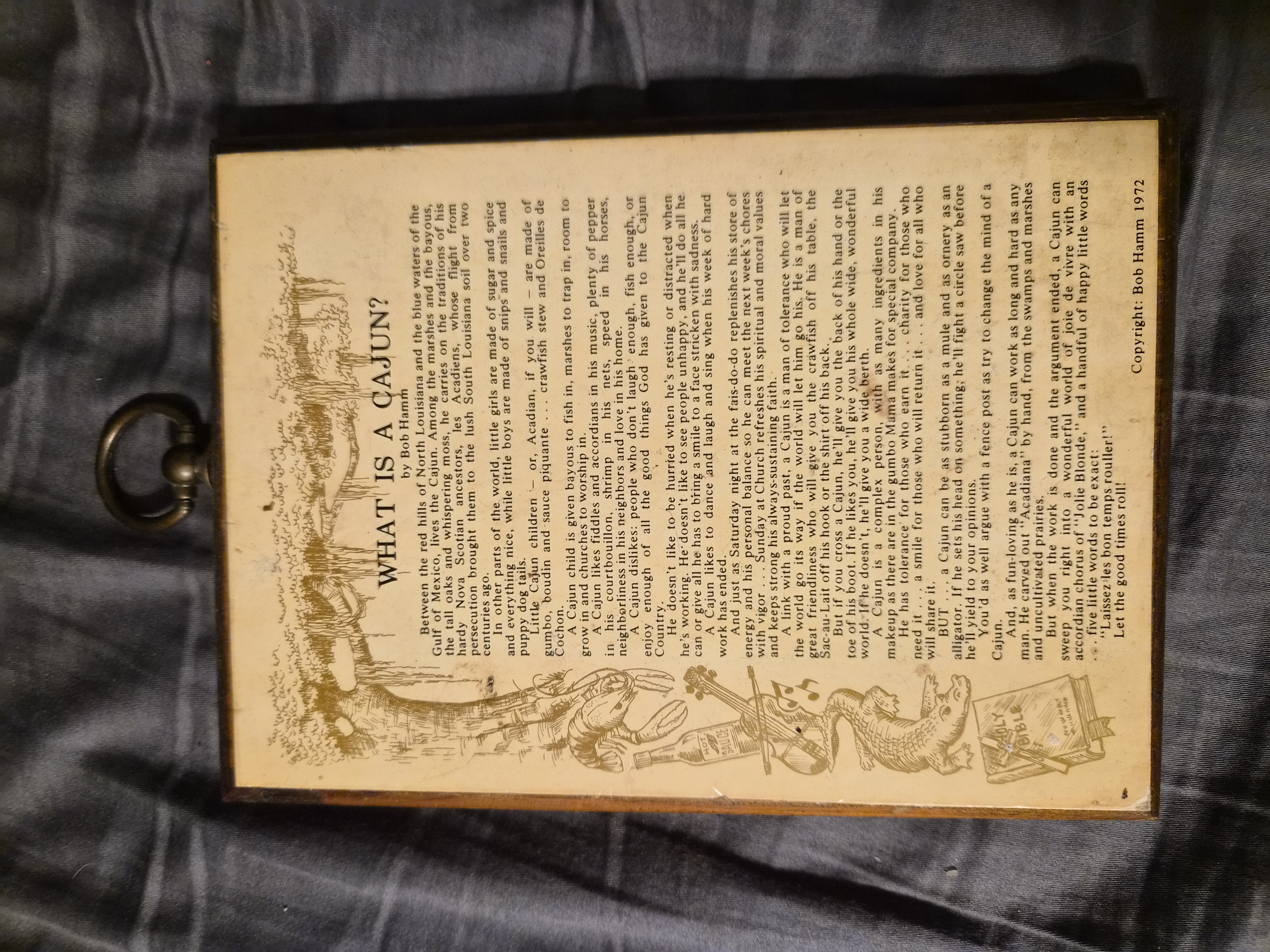
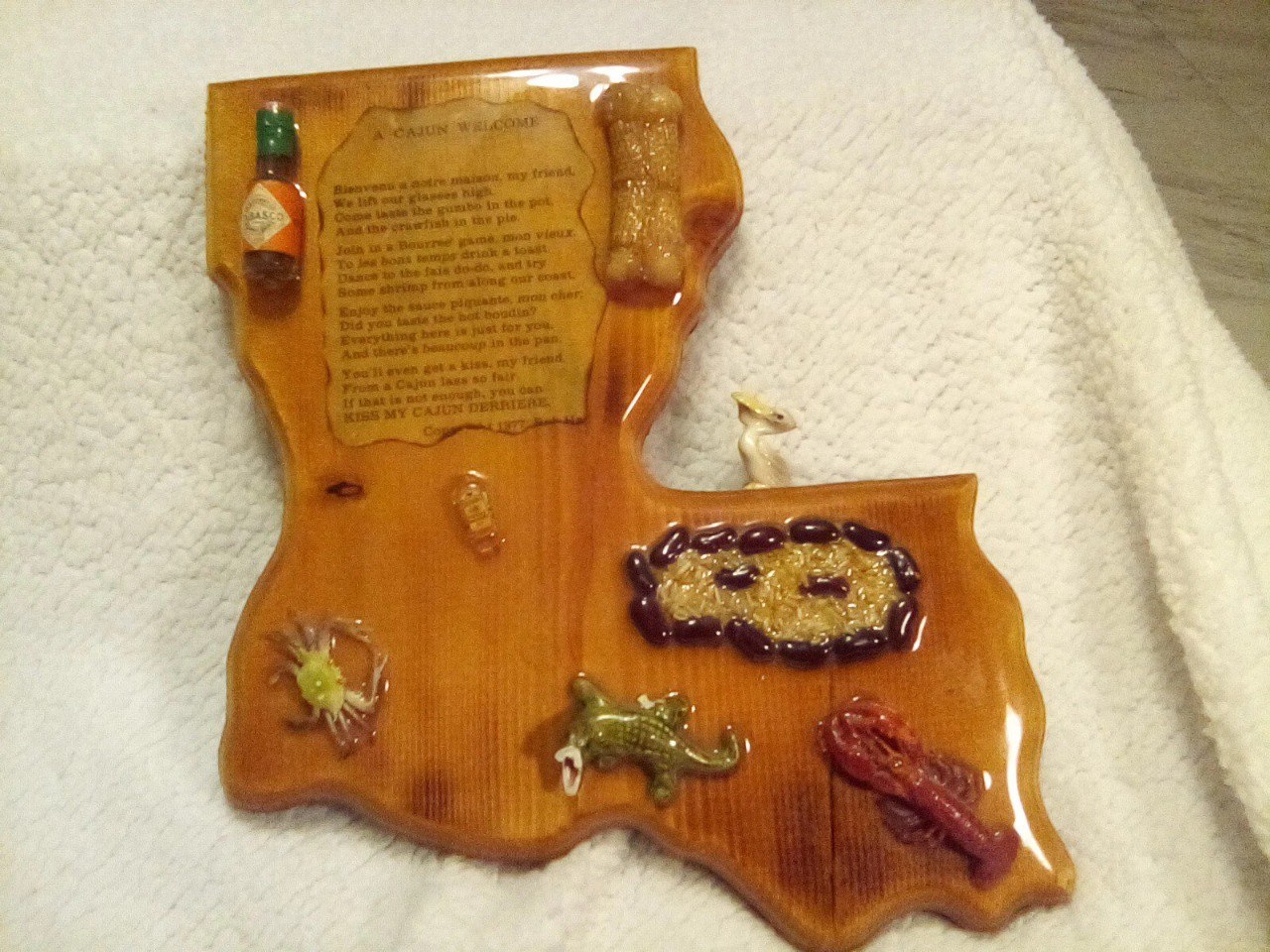
Bob wrote "What Is a Cajun?" in 1972 and "A Cajun Welcome" followed soon after. Neither was published in a book or pressed onto a record. They didn't need to be. The words spread the old-fashioned way — photocopied, clipped from the newspaper, hand-typed, and passed around until nobody remembered where they came from.
Then the decoupage artists found them. Across Acadiana, crafters pressed Bob's words onto cypress plaques, ceramic tiles, Louisiana-shaped boards, and lacquered wood. They sold them at craft fairs, gift shops, and flea markets. At one point, Bob estimated over 100,000 framed prints of "What Is a Cajun?" alone were circulating — most sold at seventy-five cents apiece, and none of them with a royalty check attached.
Plaques like these hung in kitchens, dens, and camp houses all over South Louisiana. If you grew up in Acadiana in the 1970s or 1980s, you almost certainly saw one. They were as common as cast iron skillets and as permanent as the humidity.
Cajun Nursery Rhymes
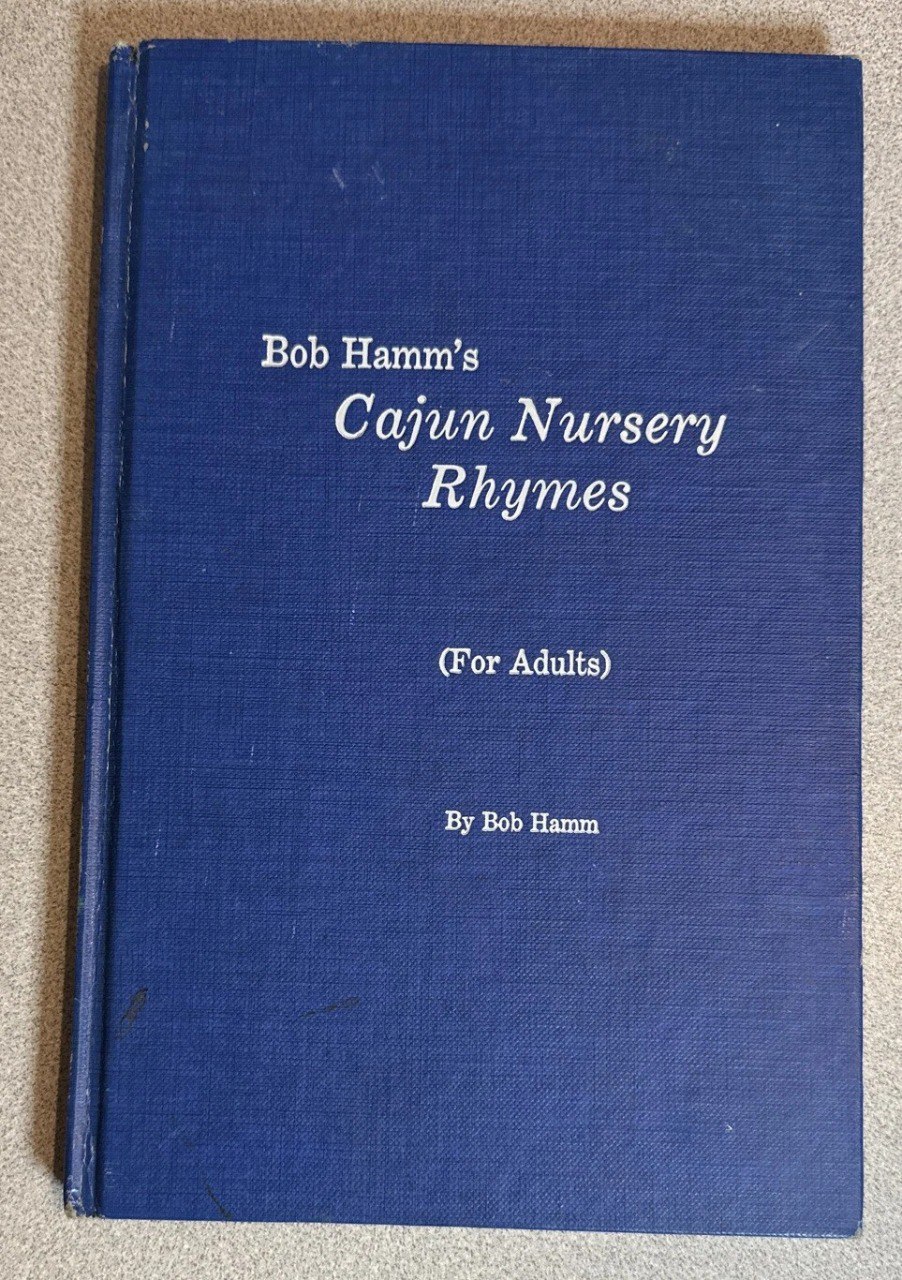
Bob took the nursery rhymes every child knows and rewrote them through the lens of Cajun life. Cajun Nursery Rhymes turned Mother Goose into something that sounded like it came off a front porch in Breaux Bridge. A second volume followed.
Bud Fletcher Goes to Washington
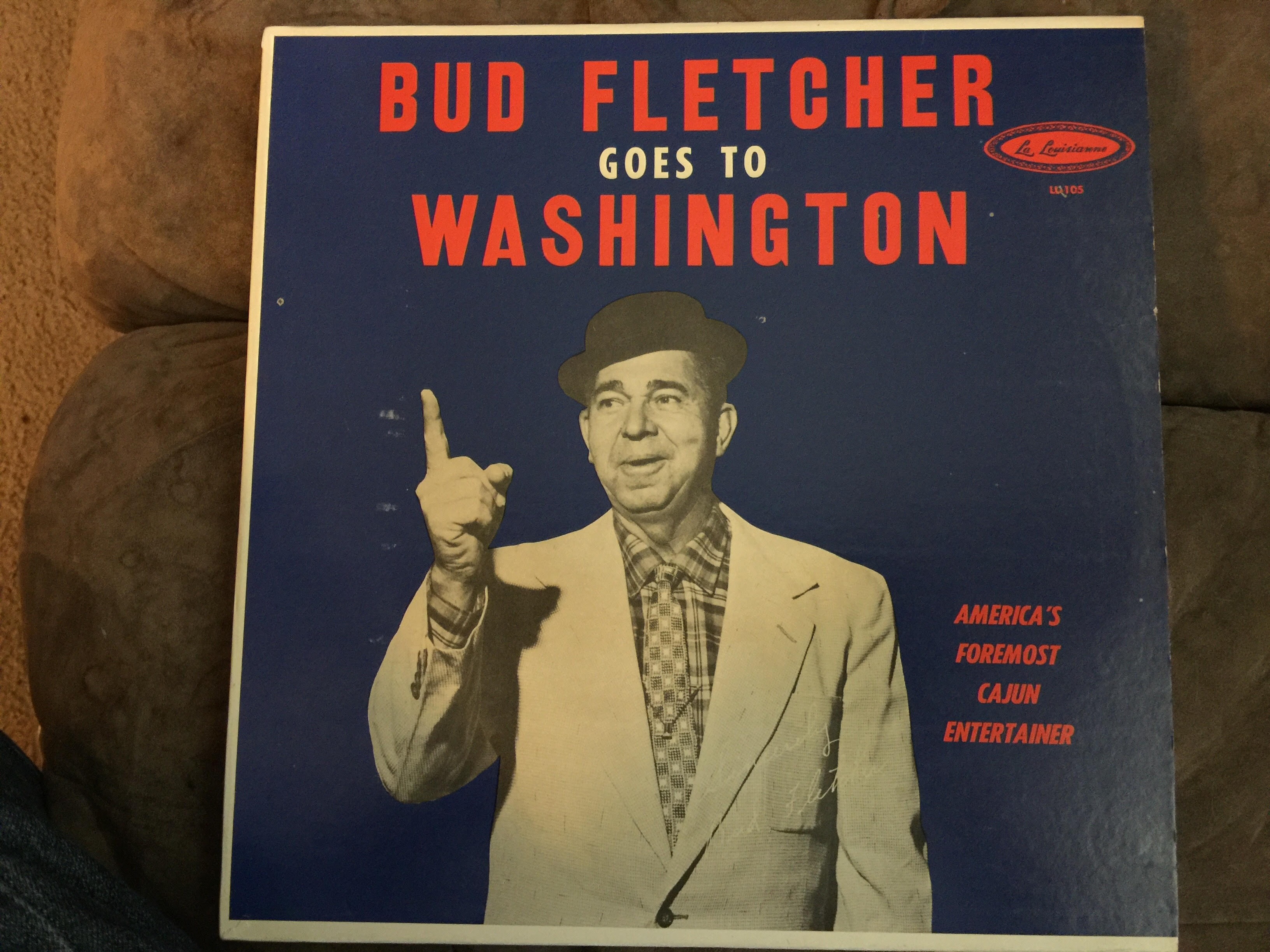
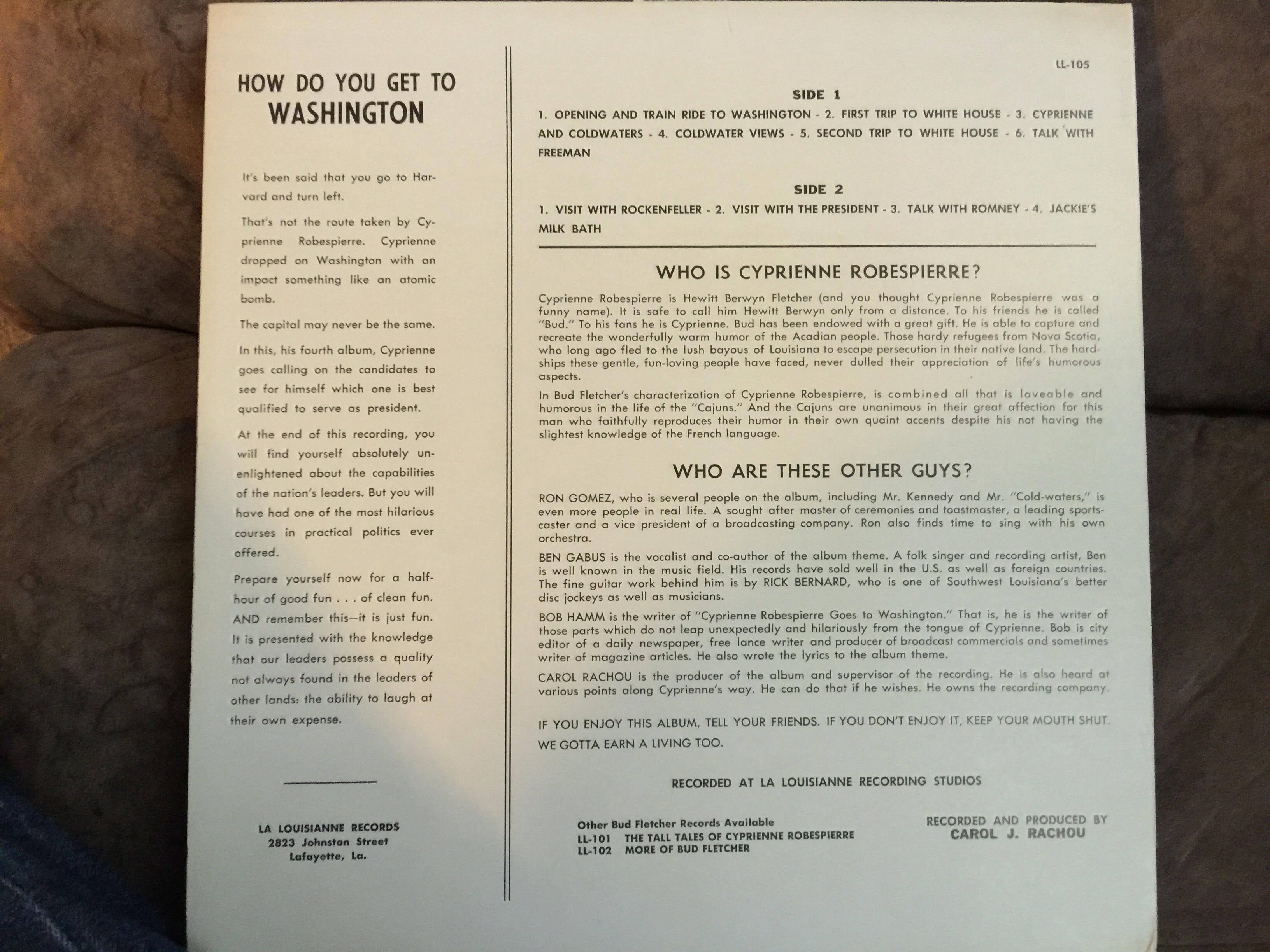
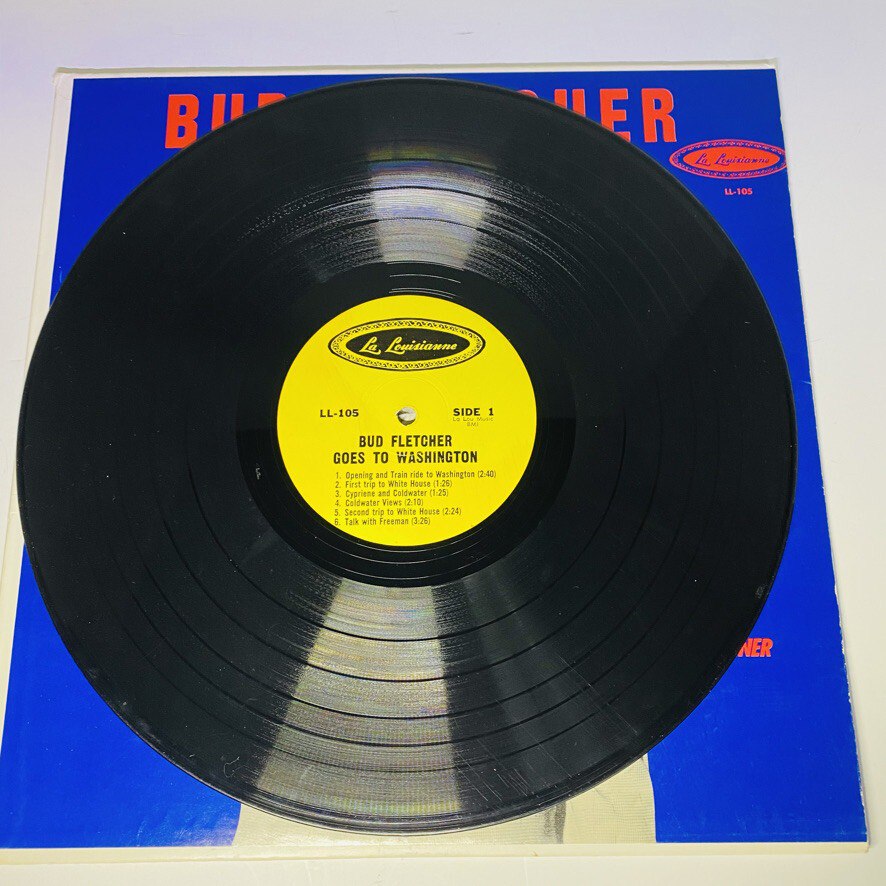
| Label | La Louisianne Records, Lafayette, Louisiana |
| Catalog | LL-105 |
| Format | Vinyl LP (mono) |
| Era | Early 1960s (pre-November 1963) |
| Written by | Bob Hamm |
| Produced by | Carol J. Rachou |
| Also featuring | Ron Gomez, Ben Gabus (vocals, theme song), Rick Bernard (guitar) |
| Other Bud Fletcher records | Tall Tales of Cyprienne Robespierre (LL-101), More of Bud Fletcher (LL-102), At the Outhouse (LL-104), Returns to the Outhouse (LL-106), Best of At the Outhouse (LL-131), 30 Years in the Outhouse (LLCD-1025, CD) |
Theme Song
Bob wrote the script for a comedy album about a Cajun everyman named Cyprienne Robespierre — his full name was Hewitt Berwyn Fletcher, but everyone called him "Bud" — who takes a trip to Washington, D.C. The album sent Bud stumbling through the Kennedy White House, Cold War politics, and federal bureaucracy, all filtered through the common sense of rural South Louisiana.
This was the fourth Bud Fletcher record on La Louisianne Records, the Lafayette label owned by Carol Rachou at 2823 Johnston Street. Bob is credited on the sleeve as the writer of "Cyprienne Robespierre Goes to Washington" and the lyrics to the album's theme song. Ron Gomez — broadcaster, MC, and vice president of a local broadcasting company — voiced several characters, including President Kennedy and Mr. "Coldwaters." Ben Gabus sang the theme. Rick Bernard played guitar.
The Bud Fletcher records were a phenomenon in South Louisiana. Locally financed, pressed in small runs, and sold through radio stations, dance halls, and word of mouth. Regional comedy like this was enormously popular before television flattened local humor into national sameness. These were front-porch political satire records, delivered in a Louisiana cadence thick enough to butter biscuits.
Then, on November 22, 1963, President Kennedy was assassinated.
Here's the tragedy: the Kennedy material on this album isn't offensive. It isn't even edgy. Kennedy is the gracious straight man — patient, intelligent, trying to help Cyprienne understand the difference between "New Frontier" and "new front ear." The humor is entirely about Cyprienne's Cajun misunderstandings of Washington, never about mocking the President. Kennedy helps him with his dead chickens. Jackie takes a milk bath. Bobby becomes "Inferno General." It's gentle, affectionate comedy.
None of that mattered after Dallas. The assassination made it impossible to laugh at anything with Kennedy's name on it — not because the content was disrespectful, but because a nation in grief doesn't reach for comedy records featuring the man they just lost. The album became unsellable overnight, not for what it said, but for who it mentioned.
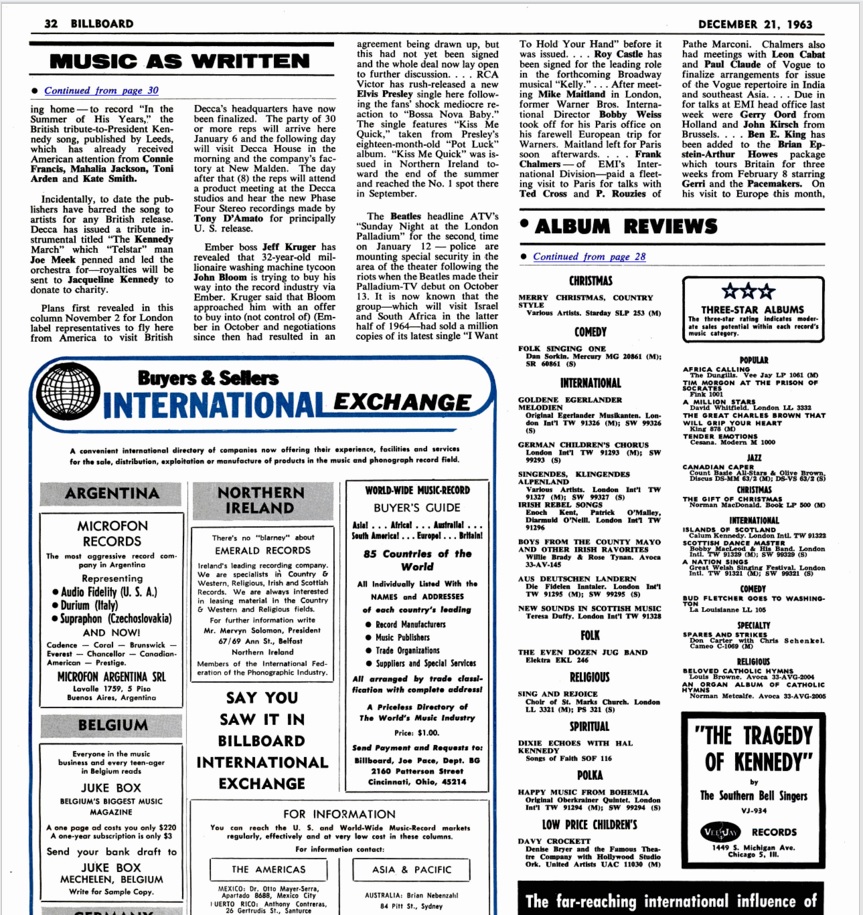
The album still earned a three-star review in Billboard on December 21, 1963 — a month after the assassination — so the industry recognized the quality. But a small-press Cajun comedy record didn't have the marketing muscle to outlast a cultural shift like that. There was no re-press, no national promotion, no second chance. The window closed.
Small-run regional comedy records were rarely preserved to begin with. People reused the sleeves, taped over them, or left them in attics until the humidity finished them off. With the Kennedy association making the album impossible to sell, surviving copies became genuinely rare — the kind of record that collectors and cultural historians get excited about when one surfaces, because so few did.
What you're hearing below was digitized from one of those surviving copies.
A Cajun Toast
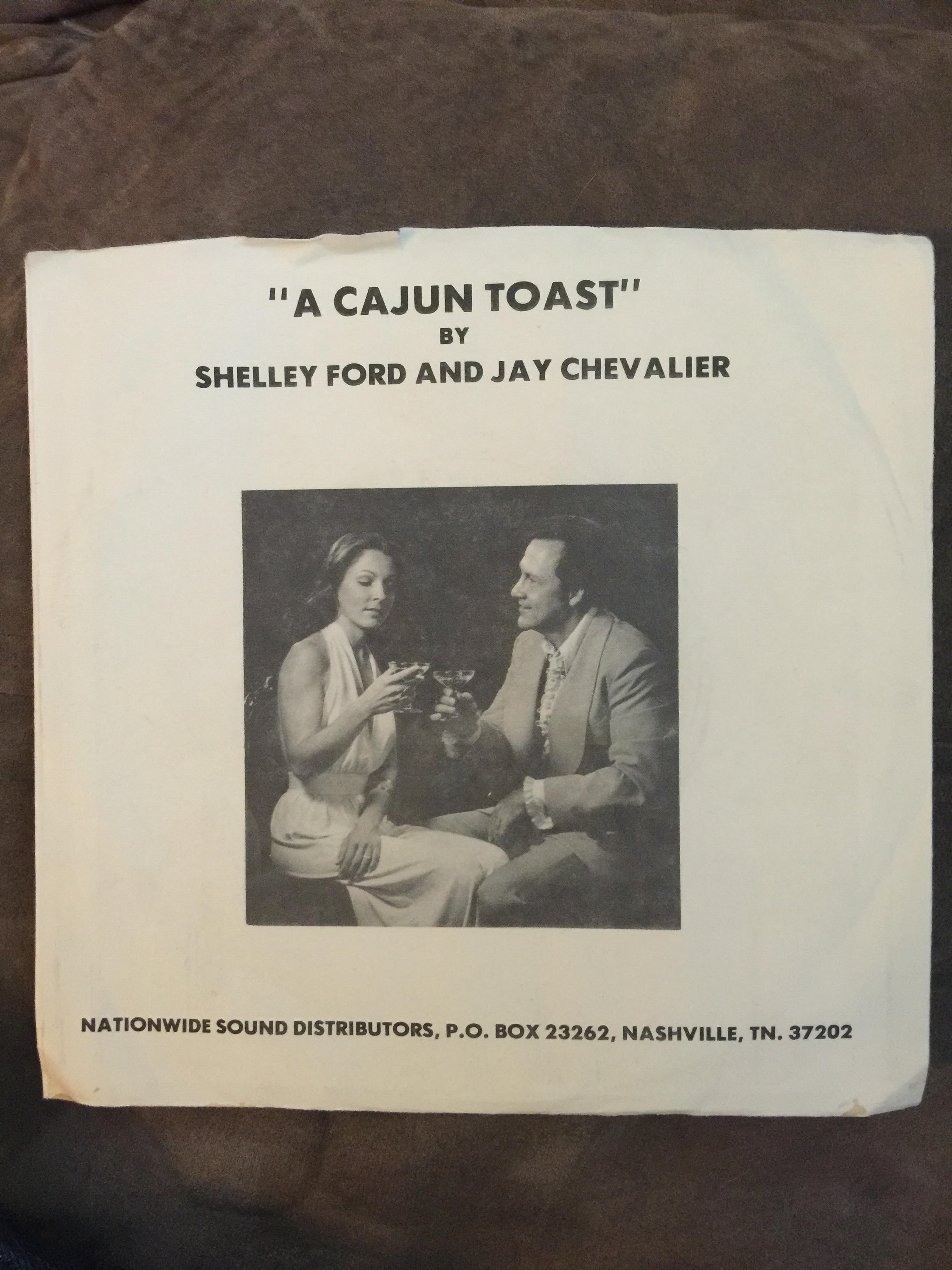
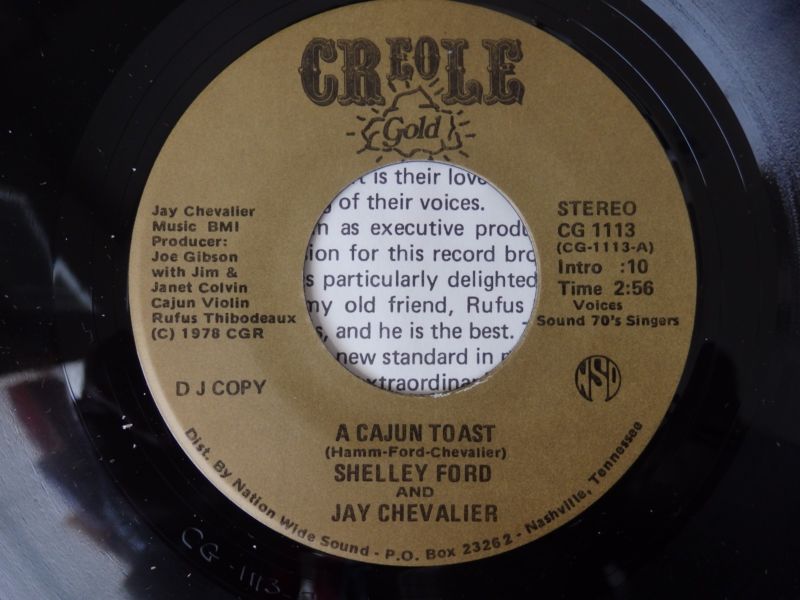
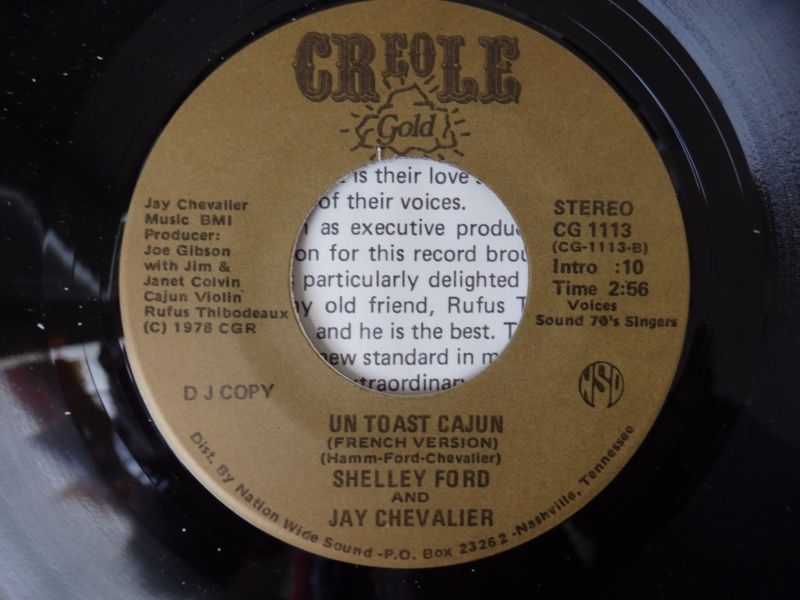
| Label | Creole Gold Record Co., Nashville, Tennessee |
| Catalog | CG-1113 |
| Format | 45 RPM single (stereo) |
| Year | 1978 |
| Side A | "A Cajun Toast" (English) — 2:56 |
| Side B | "Un Toast Cajun" (French version) |
| Written by | Hamm–Ford–Chevalier |
| Performed by | Shelley Ford and Jay Chevalier |
| Produced by | Joe Gibson with Jim and Janet Colvin |
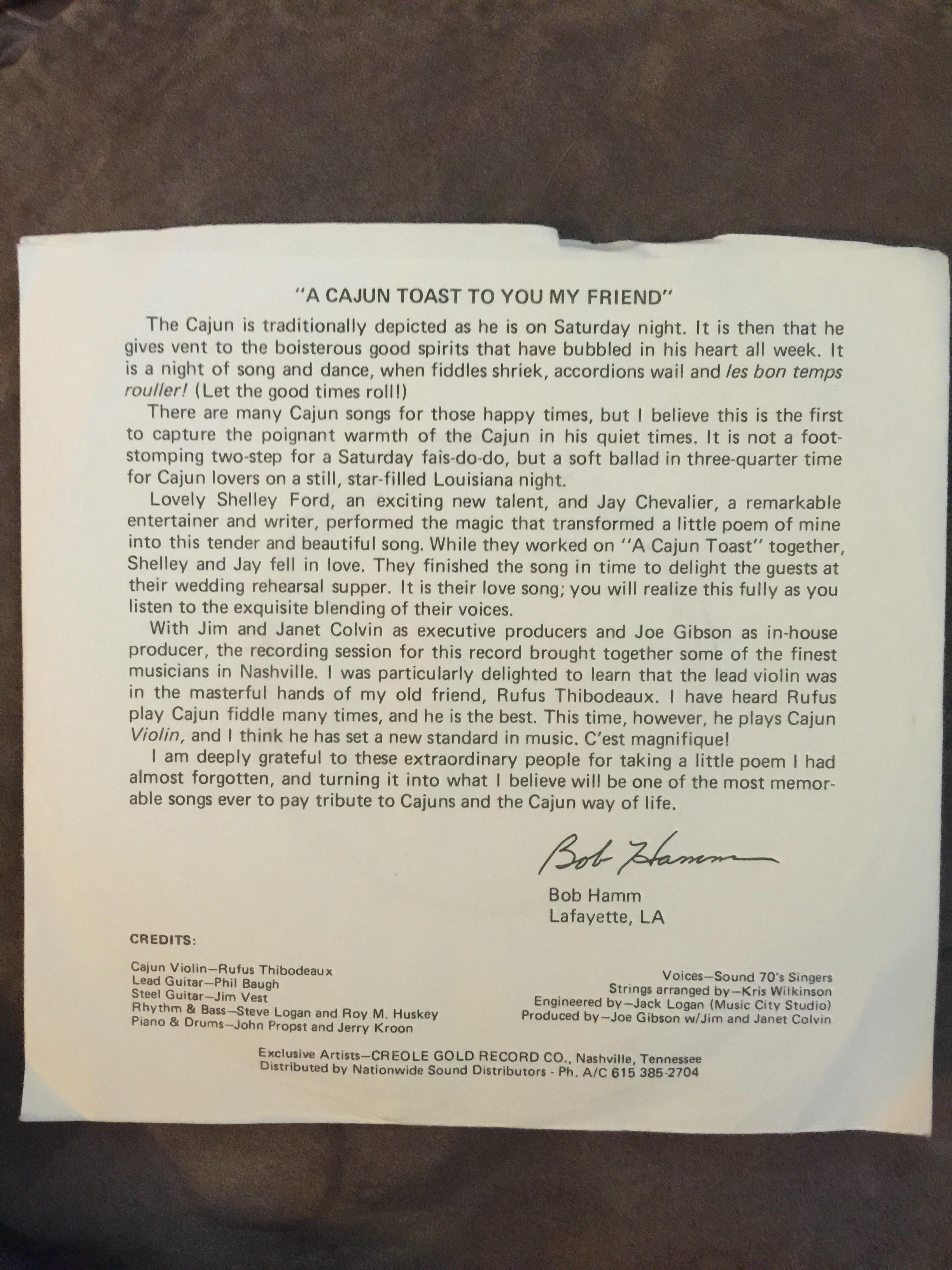
| Musicians | Rufus Thibodeaux (Cajun violin), Phil Baugh (lead guitar), Jim Vest (steel guitar), Steve Logan and Roy M. Huskey (rhythm & bass), John Propst and Jerry Kroon (piano & drums), Sound 70's Singers (voices), strings arranged by Kris Wilkinson |
| Engineered by | Jack Logan at Music City Studio, Nashville |
| Distributed by | Nationwide Sound Distributors, Nashville |
| Liner notes | Written and signed by Bob Hamm, Lafayette, LA |
Bob co-wrote "A Cajun Toast" with Shelley Ford and Jay Chevalier, and wrote the liner notes on the sleeve — signed from Lafayette, Louisiana. The songwriting credit on the Creole Gold label reads Hamm–Ford–Chevalier.
The liner notes, in Bob's words, describe the Cajun as "traditionally depicted as he is on Saturday night. It is then that he gives vent to the boisterous good spirits that have bubbled in his heart all week. It is a night of song and dance, when fiddles shriek, accordions wail and les bon temps rouler!"
The 45 was recorded in Nashville at Music City Studio with a serious lineup of session musicians — Rufus Thibodeaux on Cajun violin, Phil Baugh on lead guitar, strings arranged by Kris Wilkinson. It was a Nashville production with Cajun soul.
There's a love story pressed into this record, too. Shelley Ford and Jay Chevalier fell in love while working on "A Cajun Toast" together. They finished the song in time for their wedding rehearsal supper.
The toast itself outlasted the vinyl it was pressed on. For over fifty years, Bob's words have been raised at weddings, festivals, retirement dinners, and family reunions across Acadiana. Most of the people reciting it have no idea who wrote it. They just know it's what you say when you raise a glass in Cajun country.
Bud Fletcher: Politics and Politicians
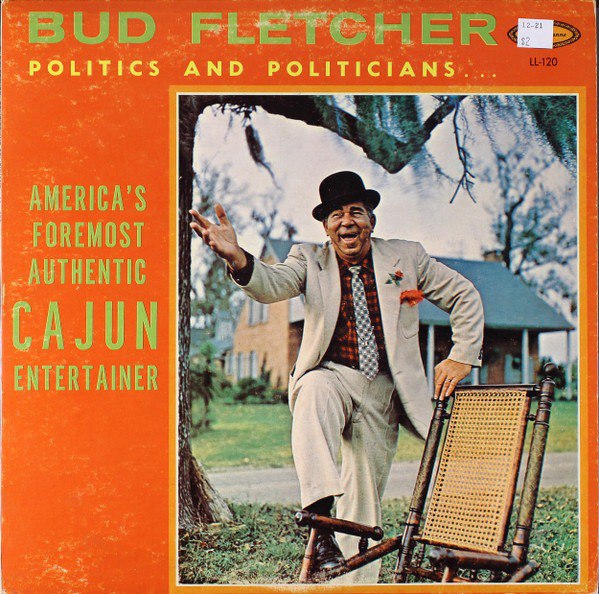
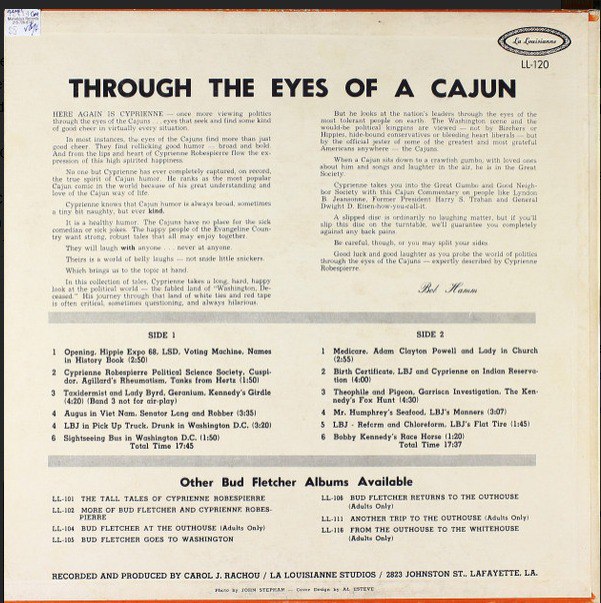
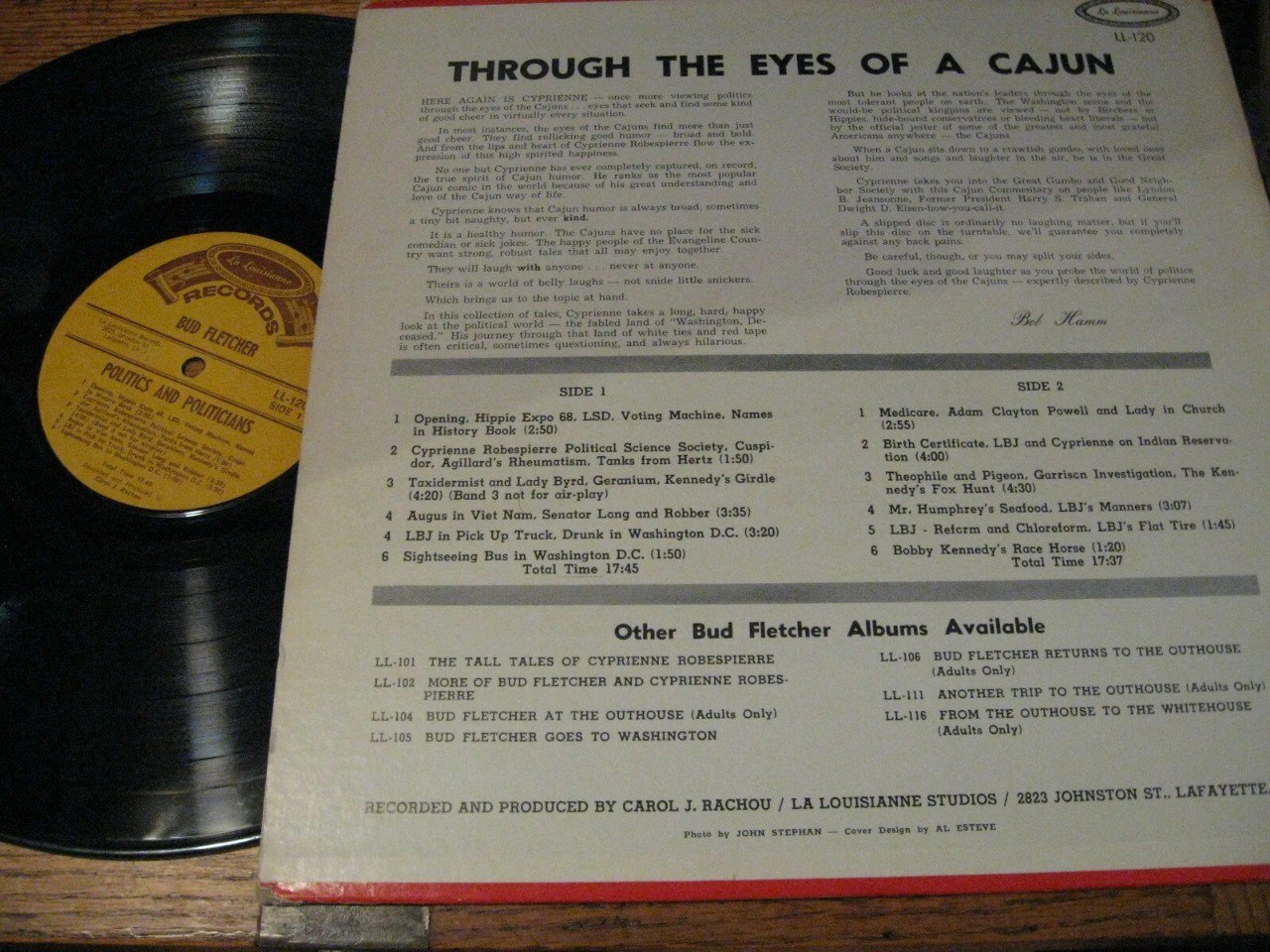
| Label | La Louisianne Records, Lafayette, Louisiana |
| Catalog | LL-120 |
| Format | Vinyl LP |
| Produced by | Carol J. Rachou, La Louisianne Studios, 3025 Johnston St., Lafayette, LA |
| Liner notes by | Bob Hamm |
"Politics and Politicians" — another Bud Fletcher album on La Louisianne Records, subtitled "Through the Eyes of a Cajun," with Cyprienne Robespierre taking "a long, hard, happy look at the political world — the fabled land of 'Washington, Deceased.'" Bob wrote the liner notes, signed from Lafayette.
In them, he captures the Cajun worldview in a single image: "When a Cajun sits down to a crawfish gumbo, with loved ones about him and songs and laughter in the air, he is in the Great Society."
The album sends Cyprienne through encounters with Lyndon B. Jeansonne, Former President Harry S. Trahan, and General Dwight D. Boudreaux — the Cajun Diplomatique Corps navigating Washington's white ties and red tape.
Better photographs and digitized audio are on the way — the Hamm family recently located and acquired a copy of this album.
Have More?
The Hamm family is collecting and preserving Bob's media — albums, recordings, broadcasts, anything that captured his work. If you have a copy of a Bud Fletcher record, a tape of a radio spot Bob wrote, photographs from a recording session, or anything else from his career, we want to hear from you.