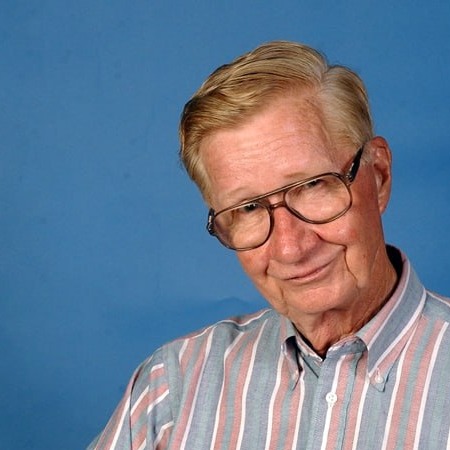
A Baton Rouge newspaper once called him "the foremost commentator on the Cajun way of life." He wasn't born into it. He found it, fell in love with it, and spent the rest of his life giving it words.
Where He Came From 1934–1960
Winnfield
Bob was born May 7, 1934, in Winnfield, Louisiana — Winn Parish country, birthplace of Huey and Earl Long — to Clinton Cason Hamm, originally from Farmerville, and Annie Belle Kelly of Winnfield. His father ran for office in Winnfield in 1938, in the heaviest vote ever recorded in the town's history. He lost. The family moved to Alexandria.
He grew up in the red clay hills of North Louisiana, where Uncle Ditimus whittled sticks on the porch and sipped whiskey every twenty minutes with clockwork precision, where his grandmother reared back in her chair at the sound of a man hollering for his wife to do everything for him, and where a boy named Jimmy Lee showed up at his father's grocery store in the colored section of Alexandria one day, said "I works here," and started sweeping.
He had a brother, Kelly "Sonny" Hamm, and sisters including Lillian Hamm Damico, Hazel Hamm Crippen, and Lorna Hamm Nelson. His people were so non-demonstrative their lips didn't move when they talked. He was a redneck, in the original, unselfconscious sense of the word — a cou rouge, as he'd later proclaim himself in Cajun country. He knew nothing about Cajuns. At that time, very few people anywhere did.
Bolton High
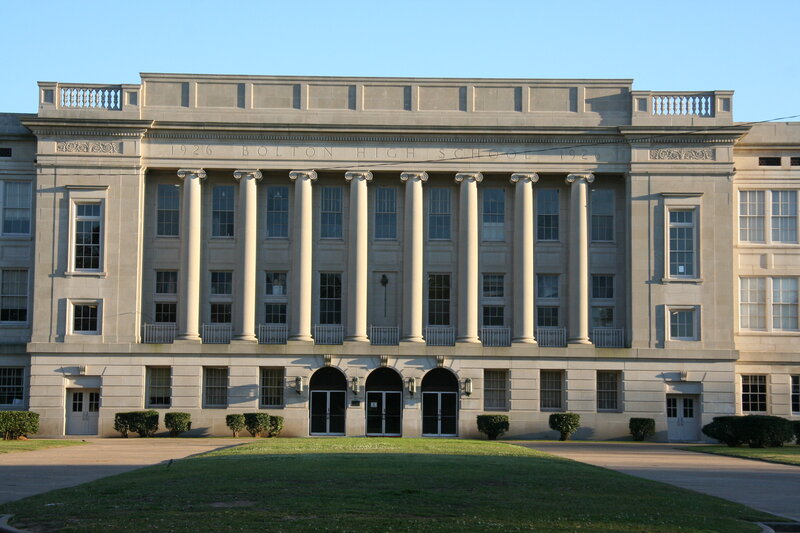
At Bolton High School in Alexandria, the kid who would spend fifty years behind a microphone was already winning radio contests. In the spring of 1952, at age seventeen, Bobby Hamm took first place in Radio Speaking, Class AA, at the Louisiana State Rally — the statewide championship. He also won first in Original Oratory and a silver medal overall. Bolton's one-act play team won the state title the same year.
He competed in everything the speech department offered — radio speaking, oratory, poetry reading, extemporaneous speaking. His Bolton teammate Rick Normand was beside him in most events. The skills he was building at seventeen — the ability to speak without preparation, to hold a room, to find the right words under pressure — would define everything that came after.
Northwestern State
Bobby graduated Bolton in the spring of 1952 and entered Northwestern State College in Natchitoches that fall. He joined the debate team immediately and by December was competing in a national tournament in Jackson, Mississippi, partnered with David Kendrick. NSC's team ranked ahead of Louisiana College and Louisiana Tech.
By March 1953, Bobby led the entire team. At the Savage Forensic Meet at Southeastern State College in Durant, Oklahoma — a field of twenty-four colleges — Northwestern finished fourth, and Bobby Hamm led with two first-place wins in individual events. The Natchitoches Enterprise put it on the front page.
He wasn't just debating. That October he'd had a role in "Royal Family," a comedy about the Barrymore family, directed by Dr. Edna West. NSC hosted the Eighteenth Annual Louisiana Speech Tournament that spring — twenty-five colleges from seven states — and Northwestern took third behind Baylor and the University of Houston. Bobby was a finalist in poetry reading, extemporaneous speaking, and storytelling.
He later attended LSU, USL, and Louisiana College. He received degrees from none of them. "I have attended LSU, USL, NSC, Louisiana College and have received degrees from none of them," he told a reporter in 1982. He later defeated the University of London in a debate — without any degree at all.
The First Radio Station
When he left college, he went to program a little radio station in White Castle, down in Iberville Parish. The station was KEVL. Within six months, the White Castle Times put him on the front page: "Bob Hamm, popular announcer of Radio Station KEVL, will be master of ceremonies for the Cane Festival on August 3rd. The popular red head has made quite a name in our area and has made KEVL the station most people listen to now."
He was twenty-two years old. He'd already made a radio station number one in its market.
The Hymels took him in. The Bajon brothers looked after him. And everything changed. He landed in a world of swamps and bayous and oak trees, and it was a different world from the hard red hills and pine trees he'd come from. It produced a different breed of people.
He found a people who were volatile, animated, prolific, witty. Religion wasn't something that happened on Sunday but was woven into everything — they began the shrimp season and the cane planting by invoking God's blessing, then went and played bourrée in the churchyard. The food was the best in the civilized world, and parts of east Texas. The language was a third English, half French, and a third something he could only describe as a melodic babel — a linguistic jambalaya he fell in love with. Within a week he'd quit talking like a boy from Winnfield and was saying mais yeah and cher little heart and poo-yi and comment c'est dit, boug.
He wanted to know where these people came from. He couldn't learn it from them. If any of the Hymels or Bajons knew the story of their origins, they didn't find it interesting enough to talk about. So he researched it himself, and never stopped.
After KEVL he did radio in Leesville — where he also ran community theater — then moved to Baton Rouge for WJBO, where he and Ron Gomez co-anchored the news. It was in Baton Rouge, probably while attending LSU, that he met Gloria Ann Lewis of Iowa Park, Texas. They married July 9, 1960, at the First Methodist Church in Baton Rouge. Kelly Hamm stood as his brother's best man.
The Newsroom 1960–1964
Bobby Richard Hamm moved to Lafayette around 1960 and joined the Daily Advertiser as a staff reporter. By February 1960, he was established enough to be named a charter member of the newly formed Lafayette Association of Newsmen, alongside Floyd Cormier (later Kurt Hamm's godfather) and Dudley Lastrapes (the same Dud LaStrape Bob would later roast in print).
Gloria gave birth to their first son, Kevin Bruce Hamm, on May 20, 1961. They were living at 113 Memory Lane in Lafayette. Bob's first bylined article appeared May 1, 1962: "Government Changes To Be Studied," covering city government reform efforts. Within months, he was promoted from "Staff Reporter" to "City Editor" — the promotion occurring sometime between July and August 1962.
His beat was the Lafayette Parish Police Jury and city politics. His front-page bylines covered everything from missing children found in the woods eating blackberries to murder investigations that took him to other parishes. In May 1963, he wrote a five-part investigative series on Lafayette's government options — commission, strong mayor, council-manager, consolidation — concluding with a call for citizen action.
Even covering routine government meetings, his prose had rhythm and personality. A November 1963 report on yet another contentious police jury session: "Parts of yesterday's police jury meeting bore a painful resemblance to a too-often-played record. All the noise was still there, and the enthusiasm of the performers, but the lyrics had been repeated many times before and everybody knew in advance how the song would end."
Jim Bradshaw later said, "He understood the rhythms of the language in a way that few writers or speakers do today." That was evident from his earliest bylines. By December 1964, when he judged a Christmas decorating contest alongside the paper's publisher and the Chamber of Commerce director, he was already being described as a "TV personality" — having left the newspaper for television.
Hammbalaya
On March 30, 1964, a new column appeared on the front page of the Daily Advertiser. The name had been chosen by public contest — Mrs. Bebe McClellan, a former columnist for the Abbeville Meridional, submitted the winning entry. As Bob announced it: she'd suggested "the natural combination of Hamm with a French potpourri of Acadian flavor, something to connote a general gathering together of dissimilar ingredients as in a Mulligan stew or a jambalaya." She crammed all that into one word: Hammbalaya.
It was the first front-page byline column the Advertiser had run since Roark Bradford did one in the 1920s. It ran most Mondays, a weekly stew of local politics, civic commentary, and the kind of humor that made people clip it out and mail it to relatives in other states. A USL student named Carrol Combs, stationed with the military in Ethiopia, got it from his sister Lil, "who sends it by plane, boat, pack mule, mountain goat or something."
Before launching Hammbalaya, Bob had already shown his flair for cultural writing. His March 17, 1964 St. Patrick's Day piece opened: "When the Loup Garou howls about the bayous tonight, it may be that one of the wee folk is sittin' astride his hairy back, digging his pointy little boots into his hide and matchin' the blood-curdlin' cry of the craythur with a bellowin' 'Erin Go Bragh.'" It was a perfect blend of Irish and Cajun folklore that proved he could capture the spirit of a culture not his own.
Through the column, Bob ran a contest to find a slogan for the City of Lafayette — "Hammbalaya had a tremendous response," he wrote, with the winner getting a coffee pot. He invented the Golden Hambone Award, a satirical honor bestowed on deserving citizens. When the newsroom presented him with an actual gilded hambone tied with a ribbon for his birthday, "openings were announced for new reporters and new friends."
When the New Iberia Naval Auxiliary Air Station faced closure, Bob wrote what the Daily Iberian quoted as the essential take: "There'll be many protests over the unquestionable effect on the area pocketbook. But, there's another consideration as well. The base has given us some good citizens. We'll miss the influx of new people, new ideas, different approaches to the business of living. Military people have made civic, social, cultural and religious contributions to our way of life. There will be a large gap when they leave . . . and it won't be just a dollar gap."
Hammbalaya was syndicated across Louisiana — the Daily World in Opelousas, the Abbeville Meridional, the Daily Iberian in New Iberia, and even the Winn Parish Enterprise back in his hometown of Winnfield. He left the column in late 1964 for television, and his successor wrote the farewell: "Now that the red-headed hillbilly from North Louisiana has decided to turn his many talents to television, Hammbalaya has come to an end."
The Man on Television 1964–1975
This is where Bob became a household name.
He joined KATC TV-3 as Public Affairs Director. His daily segment — the "Bob Hamm Feature" — aired at 5:40 PM, sandwiched between sports and Joe Holstead's local news, right before the weather. By 1968, it ran twice a day — at 6:25 in the evening and again at 10:55, just before the Joey Bishop Show. Every household in Acadiana saw Bob Hamm at dinner and again before bed.
The segment became the "Bob Hamm Special Report" — part commentary, part editorial, part civic conscience. When city commissioner Curtis Rodemacher died in 1968, the Board of Trustees' memorial statement aired on Bob's Special Report. When government overreach threatened the oil industry, Bob's editorial against it won first place for Best Editorial from United Press International Broadcasters of Louisiana. He won that award twice.
He was good at live television — quick, funny, able to make a broadcast feel like a conversation. When the anchorman's wife had a baby, Bob ad-libbed the announcement on the evening news: "Larry tried to report on the situation and started off with, 'Good ladies evening and gentlemen of the audio radiance.' So we let him off tonight to pass out cigars. Or just pass out, maybe."
He moved to KLFY-TV10 as news director — making him, at various points, the news director at two of Lafayette's three television stations. In 1971 he was a featured speaker at the Louisiana Press Women's convention, billed as "Bob Hamm, News Director, KLFY-TV." A photo caption in the West-Cal News simply read: "BOB HAMM — News Director."
It was at KATC, while editing a television trade journal for the Acadian Broadcasting Corporation, that Bob is believed to have coined the word "Acadiana" — the term now used by everyone in south Louisiana to describe the region and its culture. He didn't trademark it. He just started using it, and it stuck.
The Acadian Story
What he found in his research was one of the great untold stories in American history. The Acadians were the first North American colonists — their first permanent colony in 1604, three years before Jamestown. Hardy people from Brittany, Normandy, and Picardy who settled in what they called Acadie, in present-day Nova Scotia.
When the British took over after Queen Anne's War, they couldn't govern the Acadians. Queen Anne herself granted them freedom of religion, but after her death, the British governors grew harsher. Then came Governor Lawrence — a man Bob described, with characteristic precision, as "a black-hearted, white-livered, back-biting sidewinder." Lawrence assembled the Acadians under false pretenses, surrounded them with soldiers, and announced that their lands, cattle, and all their belongings were forfeited to the crown.
The object was genocide. They were packed into cargo boats like cattle, ill-equipped to survive a brutal winter at sea. In Pennsylvania, three ships weren't allowed to dock — over half died of smallpox aboard. In Massachusetts, New York, and Pennsylvania, the freedom-loving forefathers who had fought the British for independence forced all Acadians under 21 into indentured servitude. In Georgia, they dropped the euphemism entirely and sold them as slaves.
Yet somehow, many survived. They heard of a place called Louisiana. It took a Spaniard, Governor O'Reilly, to finally open the doors. He gave them land grants in the harsh swamps and coastal marshes of Southwest Louisiana. They arrived after a brutal, horrible, terrifying experience, and — as Bob put it — "it was like they looked around and said, 'Okay, I'm through with that.'"
And they were. They didn't pass along animosity toward the British. They didn't keep the ugly memories alive. They went on with their lives. Bob found this remarkable. His own grandfather was Irish, and kept anger toward the British that was passed down through generations until the day he died. The Cajuns just let it go.
Television, Texas, and Crowley
After television, he moved to Port Neches, Texas, where he became part owner of a weekly newspaper. Then he returned to Louisiana as managing editor of the Crowley Post Herald, where he revived the Hammbalaya column and wrote the piece that would outlive everything else — "What Is a Cajun?" It was reprinted from newspaper to newspaper across the state, and one editor who ran it said he "received an overwhelming response — phone calls, letters and comments."
He came back to Lafayette for good. He served as the first public information officer for both the City of Lafayette and the Lafayette Parish School Board — while simultaneously running his own outfit, the Bob Hamm Agency, out of St. Martinville.
The Writer
Away from the cameras, he wrote. He wrote for newspapers and magazines starting in the 1950s, long before Cajun was fashionable. He wrote about Cajuns before it was cool. Before, in fact, it was even warm.
While at the Crowley Post Herald, he'd written a piece called "What Is a Cajun?" — a poem that became the classic description of a people who had never been properly described. It was first published in a TV trade journal Bob was editing at KATC, then reprinted in the Crowley Post Herald, and from there it spread — the Times-Picayune in New Orleans, the Daily World in Opelousas, the Cameron Pilot, papers across Louisiana and eventually across the country. Over a hundred newspapers printed it. Eventually it was published as a print for framing or decoupage.
In 1974, Happy Fats LeBlanc recorded "What Is a Cajun?" as one side of a 45 RPM record, with "Tee-Boy Made the Opera" on the flip side. It was dedicated to Roy Theriot and released at a memorial Cajun Breakfast at the Bellevue Hotel on January 28, 1974.
Then he added a pair of companion poems: "A Cajun Toast" in 1973, and "A Cajun Prayer." This trilogy, in print form, sold over 100,000 copies each — at 75 cents apiece.
He wrote the "Cajun Nursery Rhymes for Adults," published by Blue Elf Publishing Company of Baton Rouge in 1979, a gift book that sold 10,000 copies before the rest of the world had even discovered Cajuns. A second volume followed by 2001. His work appeared on Hallmark cards. He recorded a comedy cassette as "Nunc Robert" — pronounced the Cajun way, Ro-bare.
In December 1985, Ernest J. Gaines — the author of A Lesson Before Dying and The Autobiography of Miss Jane Pittman — wrote Bob a letter. "You have a God-given talent for writing stories," Gaines wrote. Bob framed it and kept it on his wall for the rest of his life.
In 1977, one of his short stories was ranked seventh out of more than six thousand entries in an international competition.
"When I go outside this area, I get paid for it."
The Microphone
The Bourbon Speech
The performing career started with a shot of bourbon. Two, actually.
Bob was scheduled to speak at a convention of orthopedic surgeons in New Orleans. Twenty minutes before showtime, he downed two shots. "I got the best response I ever had received," he told a reporter years later. That was the night he joined the ranks of Cajun joke tellers. It was also, he later understood, the night the drinking started in earnest.
Nonc Robert
His first performing work was writing material for Bud Fletcher, who performed as Cyprienne Robespierre — one of the great Cajun comedy acts. When Bud passed away, another performer, Justin Wilson, became the king of Cajun humor, but he got so successful he was too expensive for many events.
So Bob stepped in himself, performing as "Nonc Robert" — Uncle Robert, Ro-bare — editor of the Passe Pas Rien Gazette, the newspaper of a fictional Cajun town whose slogan was: "Everyone in Passe Pas Rien knows what everyone else is doing. Just read to see if they got caught."
Audiences were surprised that their Cajun humorist turned out to be a redneck fellow from Winnfield. He sold an audio tape called "Nonc Robert Live" at his appearances for ten dollars — six dollars by mail. "It's good stuff," he wrote in a direct mail letter to dealers. He wasn't wrong.
KPEL and the Airwaves
In 1983, Ron Gomez — his old co-anchor from the WJBO days in Baton Rouge — hired Bob as managing editor at KPEL radio. Bob also anchored mornings on KSMB. At KPEL he co-hosted "Open Line Saturday" — later called "Prime Time" — first with Jim Bradshaw, then with Marty Melancon. It was Lafayette's first daily audience-participation radio talk show, centered around memories of Lafayette, running Saturday mornings from 7:30 to 10 AM on KPEL 1420 AM and 107.7 FM.
In 1996, readers of the Daily Advertiser voted him their favorite local talk show host.
"He was a very private person in very public jobs," said Bradshaw. "Nobody sees you on the radio. I'd come in in jeans and flip-flops and he'd have a suit on."
He always wore the suit.
The Editorial Page
Bob returned to the Daily Advertiser as chief editorial writer in the early 1990s, writing the paper's editorials and opinion pieces for more than a decade. In 2004, he was promoted to editorial page editor. "Bob Hamm is a treasure in Louisiana journalism," said executive editor Juli Metzger. "He brings a depth of understanding that is impressive."
He could write a finished editorial in thirty minutes with no preparation — colleagues watched him do it. "You'd look at the clock and think, 'There's no way he can do this,' and then it would be done," Bradshaw recalled. "And it would be good."
He won the Louisiana Press Association's Best Single Editorial award — second place and honorable mention in the same year, 2000.
The Fixer
232-HELP
For twenty-eight years, Bob served as executive director of the Southwest Louisiana Education and Referral Center — better known by its phone number, 232-HELP. It was the state's first comprehensive community referral center in health and social services, established in Lafayette in 1965. The center generated over $131,000 in community support over its lifetime.
It wasn't a bureaucratic job. When a thirteen-year-old girl named Nikki, born with Down syndrome, needed medical care her family couldn't afford, Bob coordinated volunteer support from the community — doctors, specialists, neighbors. When the calls hit 95,109 in a single year, he wrote the annual report himself. He treated every case like it mattered, because to him it did.
Acadian Ambulance
For thirty-five years — from roughly 1974 until his death in 2009 — Bob did public relations for Acadian Ambulance Service. Richard Zuschlag, the company's founder, said: "Since our company's beginning, there has not been a speech I delivered, or a press release sent out that Bob hasn't added his special touch to." Bob mentored Keith Simon, who carried on the work after him.
In 1980, Bob wrote "The Medic's Prayer," which Acadian Ambulance still uses today:
"Thank you, O Lord for our chosen field
And the chance we have to be
Instruments of thy healing power,
And links between the suffering and Thee."
The Quiet Work
Bob did public relations for anyone and anything that served Louisiana. He handled PR for LAGCOE — the Louisiana Gulf Coast Oil Exposition — for over a decade. He promoted the Acadian Village and its Cajun Heritage Festival until it ranked in the Southeast's Top 20 events. He championed Faith House, Lafayette's domestic violence shelter, through his editorials. He defended Pinecrest State Developmental Center against downsizing and closure. He wrote profiles of Petroleum Helicopters, Inc. and made 298 helicopters and 700 pilots sound like a neighbor's story worth telling.
What He Left Behind
Insight
In the mid-1980s, Bob became marketing director for Insight of America, a drug and alcohol rehabilitation hospital in Lafayette. He went there to pitch PR work. He came away sober. He was fifty-one and candid about it. "I came here cold sober," he told a reporter in 1986. "The people here did me a great service." He didn't hide it. That wasn't how he operated.
What He Gave Them
Bob gave the Cajun people words for who they were at a time when they'd been told to be ashamed of it. In 1921, Louisiana had made it illegal to speak French in schools. Children were punished for speaking their parents' language. An entire culture was told it was backward, inferior, something to be hidden.
Bob — a redneck from Winnfield who wasn't even Cajun — saw what everyone else was too close to see. He saw a people with a heritage worth celebrating, a humor worth sharing, and a story worth telling. So he told it. In newspapers, on television, on stage, in framed prints that hung in 100,000 Louisiana homes. He coined the very word — Acadiana — that gave the region its identity.
He didn't just write about Cajun culture. He helped people see it as something to be proud of.
The Tribute
Bob died on April 22, 2009, at Lafayette General Medical Center, after a lengthy illness. He was seventy-four. Monsignor Robert "Bob" Angelle officiated the Celebration of Life at La Chapelle de Martin & Castille. He was buried at Greenwood Memorial Cemetery in Pineville — back in the Central Louisiana country where he started.
Charles Lenox, the Advertiser's executive editor, who had worked alongside Bob for decades: "In my fifty years, absolutely the best." He called Bob "a co-worker for forty years, like a brother."
Jim Bradshaw: "He read everything Mark Twain ever wrote."
The Advertiser's tribute described him: "Tall, spare frame, shock of red hair mellowed with age... a bass baritone... a voice that rolled like warm thunder." He was always in the suit. He could write three of the four speeches at a local roast and nobody knew. He could walk into the newsroom with no prepared editorial, thirty minutes to airtime, and produce a masterpiece.
In lieu of flowers, the family requested donations to Faith House Women's Shelter and Pinecrest Parents Association — the causes he'd championed through his editorials for years.
"A redneck walks down the streets of Shreveport like he owns the town. A Cajun walks down the streets of Lafayette like he don't give a damn who owns that town."